
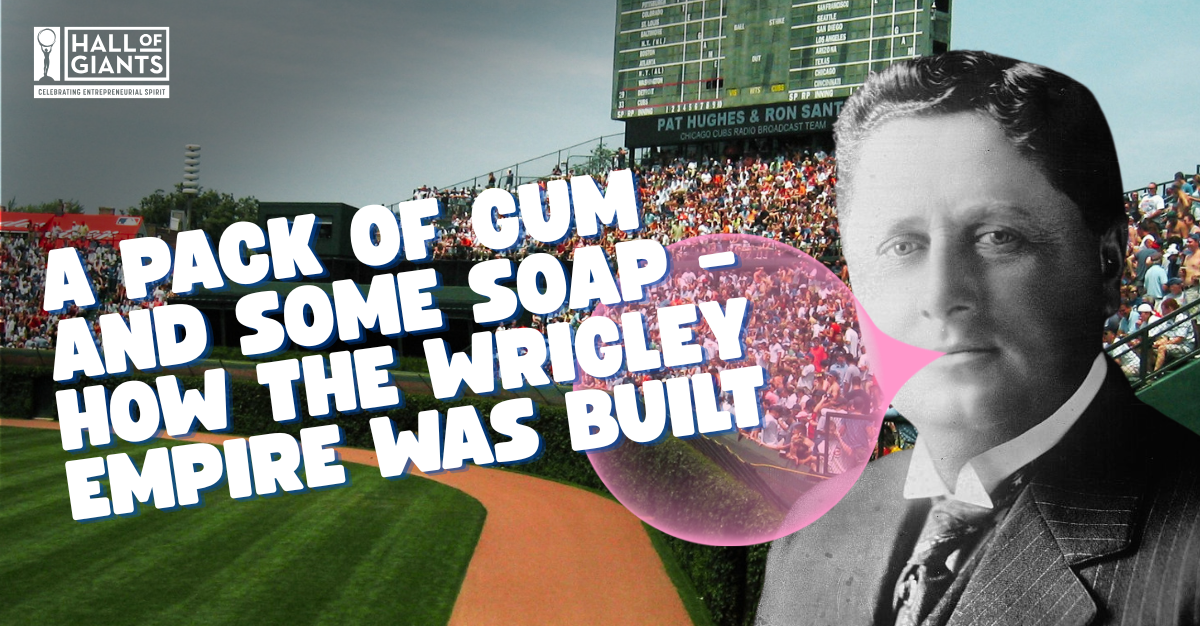
When William Wrigley Jr. arrived in Chicago in 1891, he had a dream of making it big. Wrigley had come to town with just $32 in his pocket, hoping to sell enough soap from his father’s company to start his own business.
A creative and intuitive salesman, Wrigley began including two free packs of chewing gum with his soap – a way to set himself apart from his competition and endear himself to customers. Despite tight margins, Wrigley made the gum trick work. The business grew fast.
“Even in a little thing like a stick of gum, quality is important.”
Wrigley noticed that the chewing gum was more popular than the soap. Like so many entrepreneurs before and since, he took this new information and adapted. Just two years after arriving in Chicago he introduced his first two brands of chewing gum – Lotta and Vassar. Not long after, iconic brands like Juicy Fruit and Wrigley’s Spearmint made their debuts. By 1911, Wrigley’s Spearmint was the leading gum in the country. It has remained so for over a century: walk into any convenience store today and you’ll find that brand on the shelves.
Far more than an innovative salesman, William Wrigley was also a shrewd pioneer in the use of advertising to promote branded merchandise. From newspapers ads to posters, magazines and more, Wrigley understood that to drive demand, he had to increase brand recognition. Wrigley went on to spend more than $100 million in advertising, which made him the largest single-product advertiser of his era.
By 1930, his chewing gum empire had ballooned into $12.2 million in profits. Wrigley expanded his business ventures to include real estate, mining, hotels and railroads. He built the building in Chicago that bears his name – and as many know, purchased the iconic Cubs baseball franchise.
Wrigley might have succeeded anywhere, but in choosing Chicago, his timing was ideal. The World’s Columbian Exposition — also known as the Chicago World’s Fair – was underway when he arrived. It was designed not just to celebrate the 400th anniversary of Christopher Columbus’s arrival in the New World, but as a tribute to the inventors and entrepreneurs building this still growing country.
Revolutionaries like Nikola Tesla, Thomas Edison and John Wellborn Root put their talents on display at the World’s Fair. The celebration was a reminder that America – and Chicago in particular – was where anyone could make it big. Wrigley’s story is just one of countless stories of American entrepreneurs with a knack for seeing what delighted consumers. It was just laundry soap and chewing gum, sure – but those humble items represented an opportunity that young William seized, and having seized it, built businesses that brought employment to thousands and pleasure to millions.
Bubblegum, baseball and Wrigley Field are as American as apple pie. At Hall of Giants, we understand that success stories are almost always filled with moments of both challenge and surprise. Sometimes success begins with nothing more than a crowded city, a good instinct, and thirty-two dollars in your pocket.