
Jennifer Majorana
Executive Vice President, Hall of Giants
There are few things more American than a Hall of Fame.
We have them for baseball players, football players, basketball players, rock stars, magicians, barbers, pinball machines, and toys. The National Toy Hall of Fame has even inducted the cardboard box. (Anyone who has parented a toddler – or a cat – can understand why.)
Halls of Fame preserve the stories of the things we love. They help us remember. They also serve as places for future generations to learn, and in which to find lasting inspiration.
It is also very American to argue about who belongs in a particular Hall of Fame. Does someone famous for country music or R&B belong in the Rock and Roll Hall? Does Pete Rose belong in Cooperstown? Why has my favorite wide receiver not yet received an invitation to the NFL hall in Canton? These arguments may seem silly, but they matter. It’s about more than the precise definition of a music genre, or sports statistics. It’s about whether this particular contribution is worthy of the highest and most enduring recognition.
Every Hall of Fame is ultimately an answer to the same question: Which achievements deserve to be remembered?
America has answered that question for athletes, musicians, entertainers, and dozens of other professions and pastimes. Yet one group whose contributions have shaped every American’s daily life has never had a national home of its own: entrepreneurs.
The very first Hall of Fame came close to understanding the assignment. In 1901, the Hall of Fame for Great Americans was established by New York University. Its straightforward purpose was to honor the great figures whose lives had permanently shaped the nation. That first hall’s inaugural class included George Washington, Abraham Lincoln, Benjamin Franklin, Thomas Jefferson, Samuel Morse, Eli Whitney, Ralph Waldo Emerson, and Nathaniel Hawthorne. The goal was to commemorate “the achievements of those eminent in the arts of peace as well as in those of war, the author, the inventor and the scientist, to rank equally with the warrior and the statesman.”
That first hall cast a very broad net. Perhaps too broad – it eventually lost institutional and public support. It still stands, on the campus of Bronx Community College, but it is largely forgotten. The halls that thrive and survive are those that honor a specific group. And considering the multitude of halls honoring many niche groups, it is long overdue to have a specific hall to celebrate entrepreneurs in the United States.
Entrepreneurs occupy a unique place in the American story. They start where many of us start, with a dream of a brighter future – and then, they build that future. Where others accept limitations as inevitable, entrepreneurs see the possibility for greater happiness and more enduring fulfillment. Some of these entrepreneurs become household names. Too many remain little known, even as their impact can be measured in jobs created, lives extended, and a nation strengthened.
Those stories deserve a permanent home, and they deserve to inspire the next generation of American dreamers and creators.
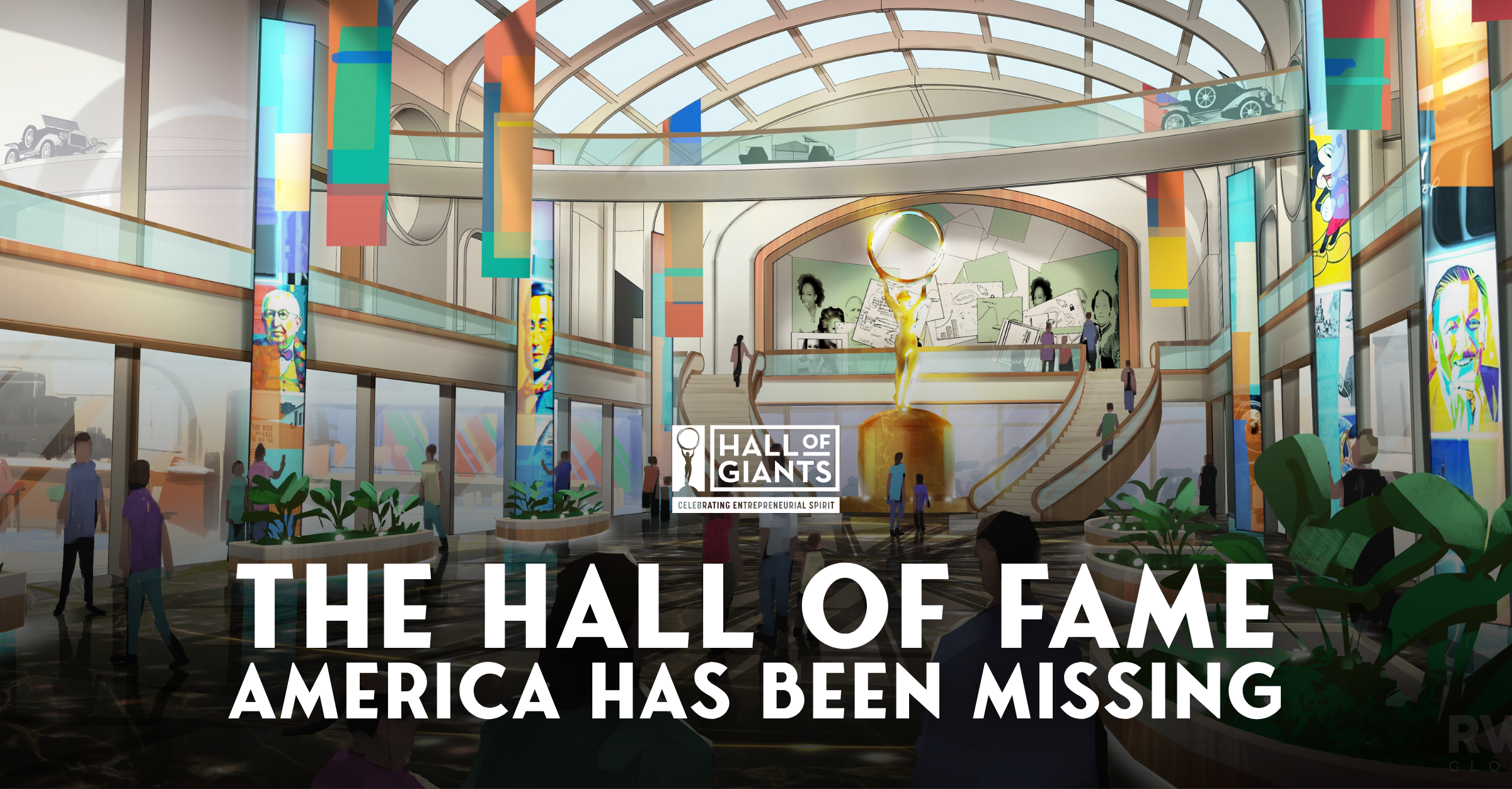
That is why Hall of Giants must be built.